
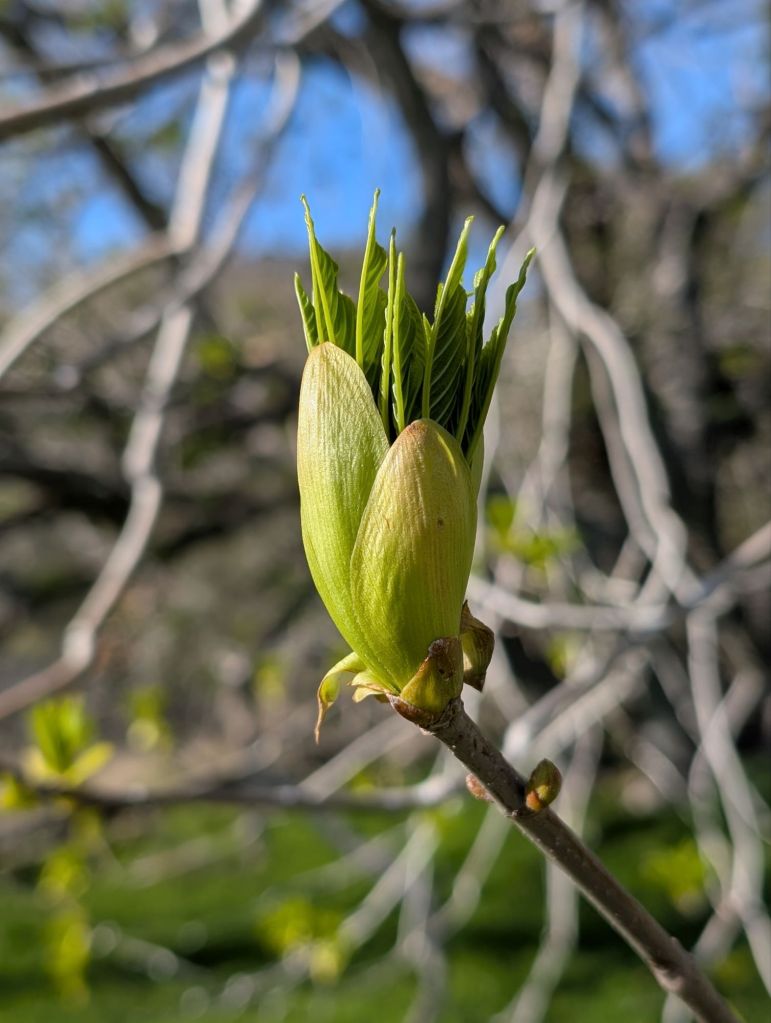
In the winter, Buckeye trees are bare and grey, with branches like frozen snakes. Once the frost recedes, the branches send out hard little buds. The buds are made of thick waxy leaves, like tiny cabbages, curled tight.
They hang in the cool air waiting for Spring.
Once it’s sunny enough, they open to let the wide and delicate summer leaves emerge, feeding the tree until winter returns.
In the photo, notice how pleasing the shape of the outer leaves is. They’re graceful, asymmetric, interesting.
Then, from out of this design, an entirely different one emerges.
Trees are masterful shapers. Each species specializes in particular shapes and colors and every individual improvises on their species’ theme.
A tree curves and ripples as it grows, riffing on the pattern in its DNA, creating a form uniquely suited to its location. It’s biologically creative, like a musician embellishing a melody.
There are mysteries. The tree, without a mind, makes beautiful shapes. Intricately shades and colors without having eyes.
The tree isn’t doing this for us, but we find it pleasing. It connects to something in us.
This is what makes wood interesting. Glass, metal and paint are amorphous until somebody shapes them, but each piece of wood has an inherent form, designed by the tree, and these forms are pleasing, even before a human gets involved.
Good woodworking is like a partnership with a ghost. The design of the woodworker depends on the intentions of the tree, and on maintaining the connection between it and us.
 Lookout Mountain Studio